
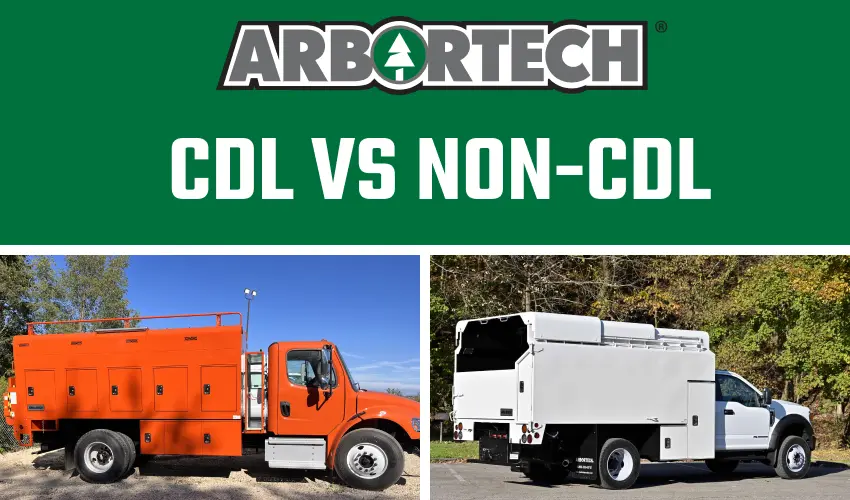
CDL vs Non-CDL Chip Trucks: Which One Is Right for You?
Choosing a chip truck can have a bigger impact than you may expect once you start putting it to work. It affects who can drive, how you schedule crews, and often you’re heading to the dump during a job.
That’s why the choice between a CDL and non-CDL chip truck matters. It’s not just about licensing. It’s about matching the truck to how your crew actually works. In some operations, a larger CDL unit pays off. In others, it slows things down. The right fit depends on your hauling needs, your crew, and the kind of work you take on.
What Is the Difference Between a CDL vs Non-CDL Chip Truck
The dividing line is the truck’s Gross Vehicle Weight Rating (GVWR). That’s the maximum weight the truck is designed to carry, including the chip truck body, fuel, tools, and payload.
- Non-CDL chip truck: 26,000 lbs GVWR or less. Typically driven with a standard license.
- CDL chip truck: Over 26,000 lbs GVWR. Generally requires a Class B commercial driver’s license.
Your setup can change the requirements. Add a heavier trailer, for example, may put your chip truck into CDL territory. When you’re planning a purchase, look at how the truck will be used on real jobs, not just the spec sheet. If needed, confirm arborist truck regulations at the federal and state levels.
Why Some Crews Choose a Non-CDL Chip Truck
A non-CDL tree service truck often makes sense when flexibility is the priority.
- More people can drive it. You’re not limited to CDL holders, which is especially important if you have a small hiring pool.
- Less overhead to manage. Fewer licensing and medical requirements means less admin work.
- Good fit for local routes. If your dump site is close and jobs are mostly residential, the capacity of a non-CDL is usually enough.
For many growing companies, this setup keeps trucks moving and crews productive without adding constraints.
Where a CDL Chip Truck Has the Edge
If you’re moving a lot of material, capacity may take priority.
A CDL truck carries more per load. That usually means fewer dump runs, less fuel burned on back-and-forth trips, and more time spent on the job. Crews handling municipal work, utility line clearance, or storm cleanup tend to see the biggest benefit.
You also get more storage for tools and equipment. On bigger jobs, that can be the difference between finishing in one run or breaking the day into multiple trips.
CDL vs. Non-CDL Chip Trucks at a Glance
| Feature | Non-CDL Chip Truck | CDL Chip Truck |
| Typical GVWR | 26,000 lbs or less | Over 26,000 lbs |
| Driver License | Standard driver’s license | Class B CDL (typically) |
| Payload Capacity | Lower | Higher |
| Driver Availability | Larger hiring pool | Limited to CDL-qualified drivers |
| Best For | Residential and growing tree care companies | Municipal, utility, and high-volume operations |
| Primary Advantage | Staffing flexibility | Productivity and hauling capacity |
Frequently Asked Questions
What size chip truck requires a CDL?
In most cases, anything over 26,000 lbs GVWR requires a commercial driver’s license. Keep in mind that certain trailer combinations can also trigger CDL requirements.
Can I tow a chipper with a non-CDL truck?
Often, yes. But the combined weight matters. A setup that is non-CDL on paper can require a CDL once a trailer is added. Check your full configuration before you buy.
Will a non-CDL chip truck be big enough as my business grows?
For many companies, it is. It allows hiring flexibility and is sufficient for day-to-day work. As volume increases, some teams add a CDL unit rather than replacing the fleet.
Does a CDL truck always mean a bigger body?
Not always. CDL chassis can support larger bodies, but the right size depends on how you use the truck.
Find the Right Chip Truck Body for Your Operation
Choosing between a CDL vs non-CDL chip truck affects more than meeting chip truck CDL requirements. It touches staffing, efficiency, and how your operation scales.
ARBORTECH builds chip truck bodies for both CDL and non-CDL setups. We focus on the body configuration so it fits how your crew works in the field. If you’re planning a new build or updating part of your fleet, we can help you choose a body that matches your setup.
Ready to get started? Request a quote and build a chip truck body that works for your business.