
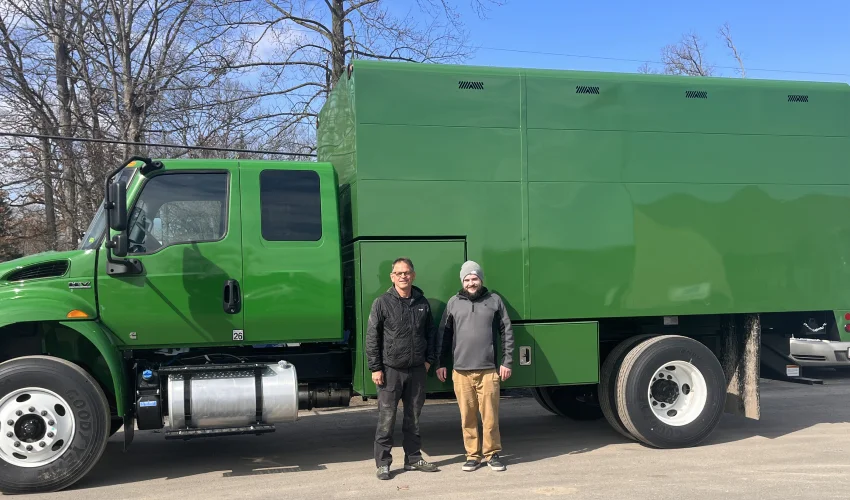
A productive tree care crew can generate an incredible amount of debris in a single day. Between brush, limbs, logs, and wood chips, even routine pruning jobs can quickly push a chip truck to capacity. On larger removals or storm cleanup projects, crews may fill a truck faster than expected, forcing additional dump trips that interrupt workflow and reduce productivity.
Many arborists focus on crew size, equipment, and scheduling when trying to improve efficiency. However, chip truck capacity is often the hidden factor in arborist crew productivity. Let’s examine the impact it has.
How Fast Can an Arborist Crew Fill a Chip Truck?
The answer depends on several operational factors, but many crews underestimate how quickly debris accumulates during a busy day.
A two- or three-person crew handling light pruning may only require occasional dump runs. However, larger crews using high-output chippers can fill smaller chip bodies surprisingly fast, especially during removals or storm response work.
Several variables influence how quickly chip truck capacity is reached, including:
Crew Size
Larger crews naturally generate more debris. A truck that works well for a two-person crew may become inadequate for a five- or six-person operation.
Job Type
Routine residential pruning creates different hauling demands than storm cleanup, municipal work, or large removals.
Chipper Output and Material Type
High-output chippers process material quickly, especially when crews are handling large limbs, dense brush, or wet debris.
Distance to Disposal Sites
Companies operating far from disposal facilities lose more time during each dump trip, increasing the importance of larger hauling capacity.
Seasonal Demand and Business Growth
Peak trimming seasons, storm response work, and growing crews can all increase hauling demands throughout the workday.
For example, a four- to six-person crew working on a large removal may generate enough chips and debris to fill a lower-capacity truck before lunch. The crew must then pause their work for a dump run, stopping momentum in its tracks.
The Hidden Cost of Dump Trips
When a truck leaves the jobsite to dump debris, crews lose valuable production time that cannot be recovered. Depending on the distance to the dump site, one trip can easily consume 30 to 60 minutes or more. That lost time adds up quickly, resulting in hours of lost operational capacity.
For companies operating in rural service areas or regions with limited disposal access, these inefficiencies become even more noticeable.
Add in the fuel and truck maintenance costs associated with these additional trips, and you can see how limited chip truck capacity directly impacts your bottom line.
How Chip Truck Capacity Impacts Jobs Completed Per Day
Every interruption affects scheduling.
The more time crews spend on dump trips, the less time they spend completing jobs. If hauling limitations require multiple off-site trips per day, arborist crew productivity is constrained regardless of how efficient they are.
In many ways, chip truck capacity sets the operational ceiling for the business. It affects how confidently companies can take on larger or more demanding projects.
For growing arborist companies, reducing capacity constraints can create measurable improvements in profitability and scheduling flexibility. That additional uptime can improve job flow, reduce delays, and increase the number of jobs completed each week.
How Capacity Can Define Your Daily Earning Potential
Many companies do not realize the productivity they lose until they track it directly.
A simple evaluation can provide useful insight:
- How many dump trips does the crew make per day?
- How long does each trip take?
- How often does work pause because the truck is full?
- How many jobs could be completed with fewer interruptions?
Even modest reductions in dump trips can create meaningful improvements in labor efficiency over time.
For example, saving one hour of downtime per day across a full crew can translate into substantial gains over the course of a season.
Truck capacity is not just about storing debris. It is a productivity tool that directly affects how efficiently crews operate in the field.
Key Takeaways
- Larger crews generate debris faster than many companies expect
- Frequent dump trips reduce uptime and productivity
- Chip truck capacity directly affects scheduling flexibility
- Higher-capacity chip bodies can reduce operational bottlenecks
- Hauling efficiency impacts profitability
Small vs. High-Capacity Chip Bodies
Smaller chip bodies can make sense for certain operations. They may offer easier maneuverability in tight urban environments and lower upfront costs for growing businesses.
However, smaller bodies typically require more frequent dump trips, especially as crews become more productive.
High-capacity chip bodies help reduce those interruptions by allowing crews to stay on the jobsite longer and haul more material between trips.
For larger operations, the difference can significantly impact daily workflow.
Smaller Chip Bodies
- Lower upfront investment
- Easier navigation in compact areas
- More frequent dumping
- Potential production bottlenecks for larger crews
High-Capacity Chip Bodies
- Longer uninterrupted work periods
- Fewer dump trips
- Greater hauling efficiency
- Better support for high-output crews
- Increased daily production potential
As tree care companies scale, chip truck capacity often becomes the limiting factor. Even highly skilled crews and powerful equipment cannot maintain productivity if the truck body fills too quickly.
The Chip Truck Body as a Productivity Tool
Tree care companies invest heavily in skilled labor, equipment, and scheduling to maximize productivity. However, chip truck capacity is often overlooked as a factor that influences daily output.
The reality is simple: when the truck fills up, production slows down.
Reducing dump trips and increasing hauling efficiency allow crews to stay focused on completing work rather than constantly managing debris logistics.
For many arborist operations, the right chip body capacity is not just a convenience. It helps determine how much work crews can realistically complete in a day and how efficiently the business can grow.
If your current setup is creating unnecessary downtime, it may be time to evaluate whether your hauling capacity is supporting or limiting your operation. Contact Arbortech to find the right chip truck body for your team.